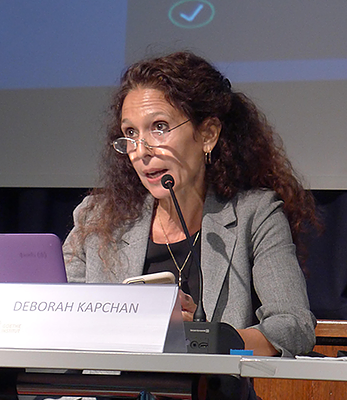
"Kapchan is at her most revelatory when she’s exploring spirituality itself as a kind of endless search for meaning....Astute and nunaced, this resonates."
— Publisher's Weekly

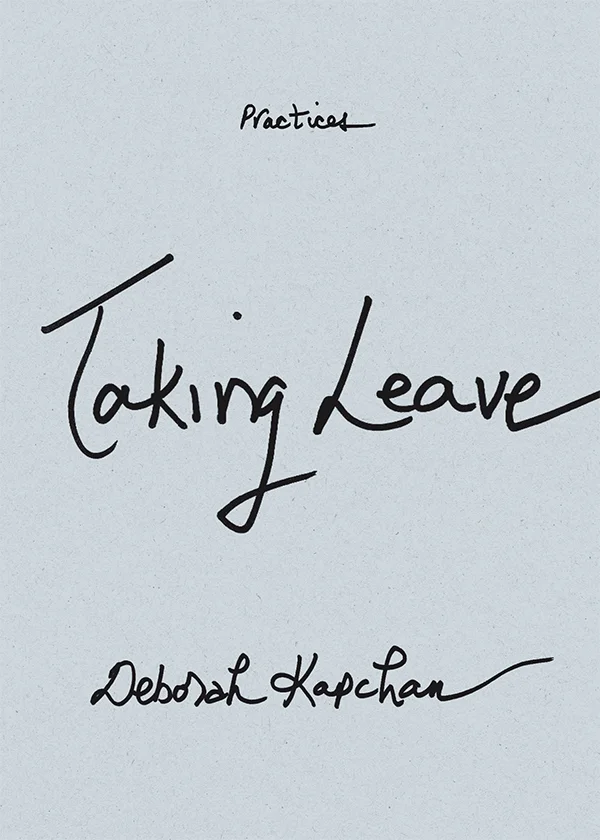
Deborah Kapchan’s Taking Leave is a lyrical memoir that encompasses journeys both inner and outer, physical and spiritual.  Taking readers from New York, Paris, and Casablanca to Jerusalem and Abu Dhabi while exploring her Christian childhood, Jewish lineage, and the release she found in Islam, Kapchan examines the extent to which we can take leave of who we are to live between categories. She meditates on absence, presence, and the sublime to weave an existential tale that honors the three traditions that made her, ultimately desiring to take leave of them all. 

“This book is a joy to read, speaking deeply and powerfully to a shared and fundamental human experience by means of Deborah Kapchan’s unique vision and voice. I adore this touching and remarkable book.”

Martin Shuster, author of How to Measure a World? A Philosophy of Judaism

0:00 / 0:00
radio free mike interview

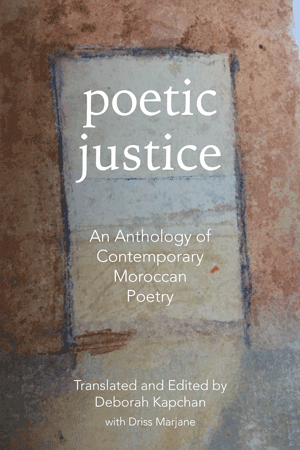
Translated and Edited by Deborah Kapchan

“This volume is an outstanding contribution to knowledge, to modern Moroccan poetry and in an extended sense, to modern Arabic poetry; to the societies and cultures within Morocco out of which these poems emerge and which they reflect or challenge; and to contemporary English and particularly the American poetic idiom.”

Michael Sells, Emeritus Barrows Professor of the History and Literature of Islam

gnawa-music-morocco-deborah-kapchan.png

Traveling Spirit Masters
Moroccan

Trance Music in the Global Marketplace 

Gnawa heal those they believe to be possessed with music and trance. As a group of ritual musicians originally from sub-Saharan Africa, the Gnawa have been living in Morocco for centuries and have long participated in the world music market. In this first book in English on Gnawa music and its global reach, author Deborah Kapchan explores how these collaborations transfigure racial and musical identities on both sides of the Atlantic.

Learn more        Order here

gender-market-Deborah-kapchan.png

Gender on the Market

This book is the result of extensive ethnographic research on Moroccan women’s expressive culture and the ways in which it both determines and responds to current transformations in gender roles. Beginning with women’s emergence into what has been defined as the most paradigmatic of Moroccan male institutions—the marketplace—the book elucidates how gender and commodity relations are experienced and interpreted in women’s aesthetic practices.


Learn more      Order here

sound-writing-kapchan.png

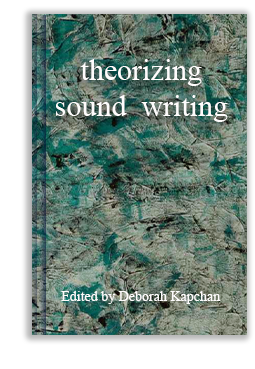
Theorizing Sound Writing

This volume contains an impressive lineup of scholars from anthropology, ethnomusicology, musicology, performance, and sound studies. More

Learn more      Order here

Cultural-Heritage-Transit-Deborah-Kapcha

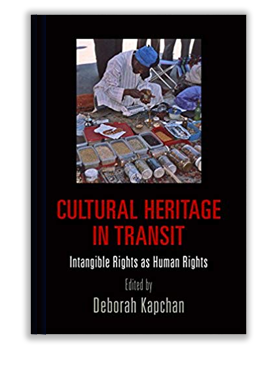
Cultural Heritage in Transit

This volume examines the intangibilities of human rights in the realm of heritage production, focusing on the ephemeral culture of those who perform it as well as the ambiguities present in the idea of cultural property.

More

Learn more     Order here

Listen

to an excerpt of a sound project in Fårö, Sweden about how sound affects us, how it vibrates the environment and why ways of listening are connected to feelings of home. 


The Aesthetics of Proximity

Watch a presentation on the “auditory sublime” at Phenomenology in Ethnomusicology

Conference at Memorial University of Newfoundland in June 2018. In the presentation she describes the sublime both an aesthetic category that structures philosophical thinking as well as a structuring affect – something that co-creates human sociality, like mourning, anger, or effervescence

 More on the media page 

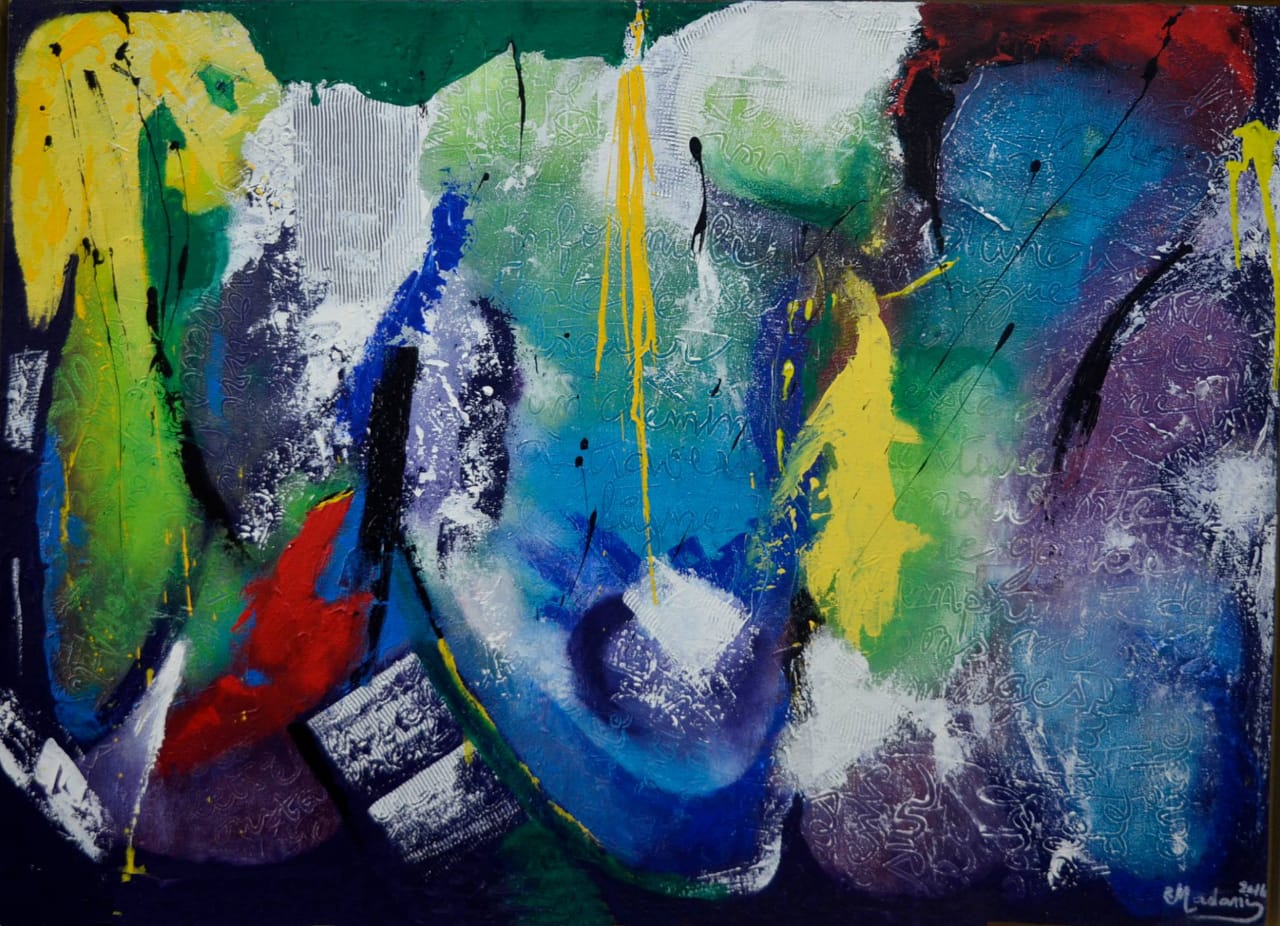
Art of the Maghreb

Select Moroccan Painters

By Rachida Madani

Painting by Rachida Madani

Latest posts from the Sound Collector blog

Listening to the Sounds of Home on Fårö

       “If one were to be formal, one could say that I had found a home, a true home.” — Ingmar Bergman about his first meeting with Fårö     Bergman found his home on the island of Fårö and proceeded to build a dwelling there. Not only did he inhabit the house he built, but his films found their “location,” their home, on the island. What does it mean to find a “true home” – not the home of one’s birth but one found as an adult? How did rauks and stones, the sound of the wind through pines and the cries of seabirds create a feeling of home in Bergman’s life as in his films?  

Read More »

Fårö Document

“Our relation to place is irrational. There are things that surpass reason therein. There always remains an unknown and invincible power (magnetism, magic, gravity,…) that ties us to a path, a dwelling, a city, a countryside, a hidden place in a residence, in a garden. ….we are secret characters in a grand and multi-century story that places are recounting.” Idriss Aissa  

Read More »